
Welding Automation in the Automotive Industry
Leave a Comment Welding automation is the process by which technology, instead of human labor, is used to join materials together, resulting in a process that is safer, faster, higher quality, and more efficient than manual labor. Welding automation typically uses robots, but can also use a servo with the same X, Y, Z coordinates used in programming robots to increase the performance of production welds. These two systems can reduce the chances of errors or inconsistencies occurring in manual welding processes. Because these robots or servos are computer-based, they can be programmed to smoothly and precisely follow a specific path along a seam and make corrections as needed. Overall, although welding is an incredibly complex manufacturing process, automated welding can dramatically increase the productivity, quality, and profitability of many processes — especially those in the automotive industry.
Welding Automation In Automotive Manufacturing
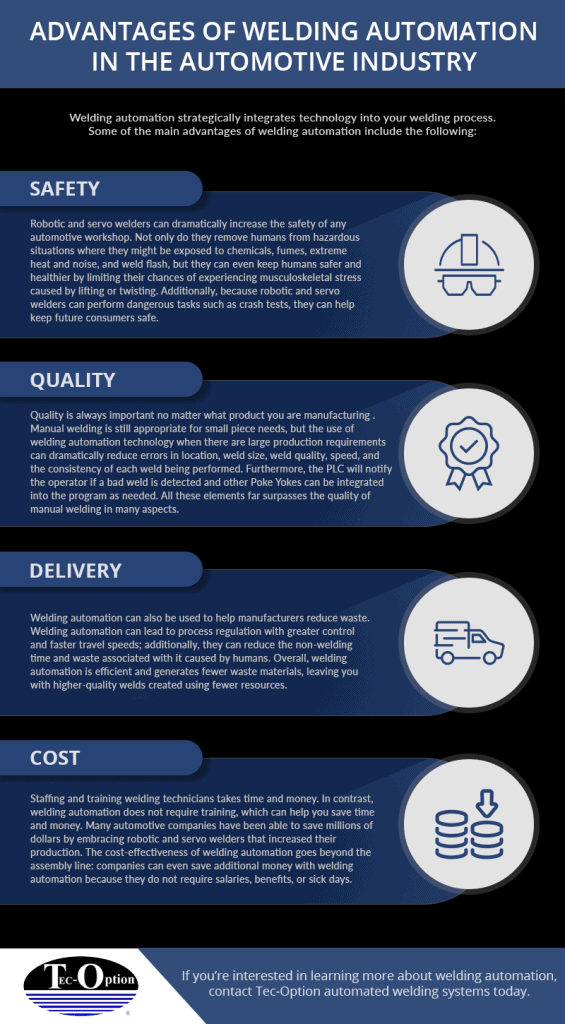
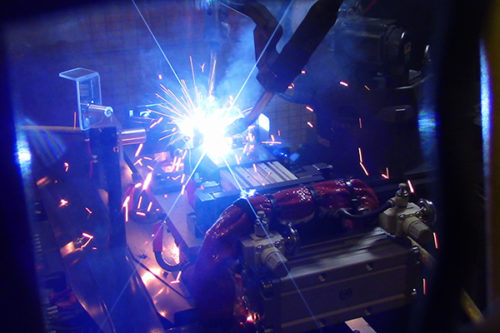
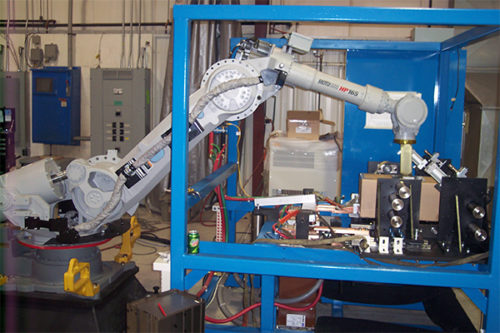
Typically, a welding automation setup involves the use of several different types of robots. Large robots are commonly used to handle spot welding on heavy car body panels due to their long arms and high payload capabilities. In contrast, smaller robots can weld lighter parts, such as mounts and brackets. Robotic MIG and TIG welders are also commonly used because they can position their torches in the same orientation every cycle. Because these robots have repeatable arc and speed gaps, they can meet high welding standards.
Contact Us
Advantages of Welding Automation in The Automotive Industry
Welding automation strategically integrates technology into your welding process. Some of the main advantages of welding automation include the following:
Safety
Robotic and servo welders can dramatically increase the safety of any automotive workshop. Not only do they remove humans from hazardous situations where they might be exposed to chemicals, fumes, extreme heat and noise, and weld flash, but they can even keep humans safer and healthier by limiting their chances of experiencing musculoskeletal stress caused by lifting or twisting. Additionally, because robotic and servo welders can perform dangerous tasks such as crash tests, they can help keep future consumers safe.
Quality
While human welders may be skilled, welding automation technology is far more efficient. Automated equipment is capable of completing jobs more quickly and consistently than manual laborers, and they’re even able to meet industry standards within tight time constraints and without any delays. Additionally, welding automation equipment can produce tighter welds and perform highly intricate tasks, thus making them more efficient than human welders and able to keep up with changes in automotive industry standards.
Delivery
Welding automation can also be used to help manufacturers reduce waste. Welding automation can lead to process regulation with greater control and faster travel speeds; additionally, they can reduce the non-welding time and waste associated with it caused by humans. Overall, welding automation is efficient and generates fewer waste materials, leaving you with higher-quality welds created using fewer resources.
Cost
Staffing and training welding technicians takes time and money. In contrast, welding automation does not require training, which can help you save time and money. Many automotive companies have been able to save millions of dollars by embracing robotic and servo welders that increased their production. The cost-effectiveness of welding automation goes beyond the assembly line: companies can even save additional money with welding automation because they do not require salaries, benefits, or sick days.

Tec-Option: Your Partner and Expert for All Welding Automation Needs
Welding automation is a useful way to improve the quality of your welds while also saving money, reducing waste, improving the safety of your workshop, and meet the deliveries required by today’s markets. If you’re interested in learning more about welding automation, contact Tec-Option Automated Welding Systems today. Our experienced team is excited to help you see the benefits of robotic welding technology in the automotive industry for yourself.
 Train Your Team
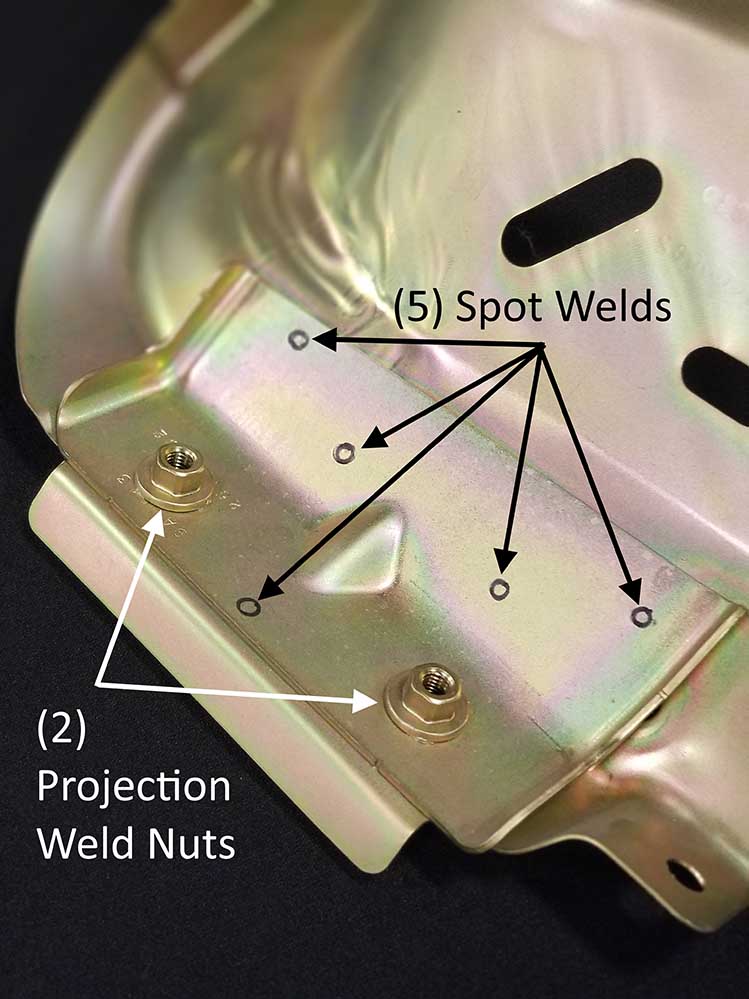 This is an excellent question for there are several types of welds used within the industry and each has its specific function. Spot welding is the most common and used for many types of assemblies. But there is also projection welding which adheres a nut or threaded stud to an assembly. There is also MIG welding (metal inert gas) that is common for stronger weld applications. Lastly there is a weld type known as drawn arc weld and that is used for more specific applications.